
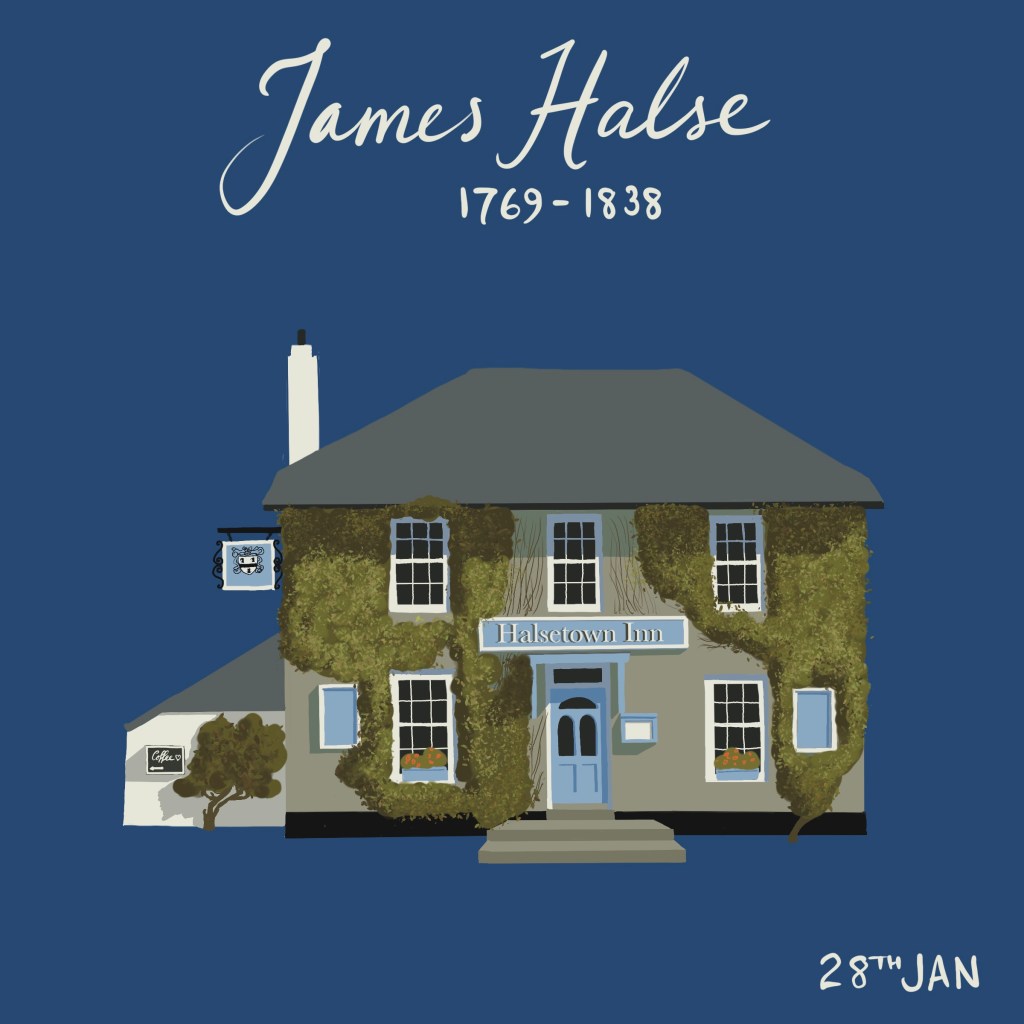
28th January 1769
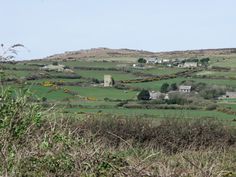
Halsetown, near St Ives was the first planned village in Cornwall, and one of the earliest planned settlements in England. It was created by lawyer and politician James Halse who was born on 28th January in 1769.
James Halse was the owner of the local mine and also the MP for St Ives from 1826 to 14th May 1838 when he died. He had come to St.Ives in 1790 as a lawyer and soon was one of town clerk and alderman.
He invested in mining, reopening the Wheel Reeth and also opened St Ives Consul mine in 1818. Creating Halsetown was a means to create a pool of captive voters, and also was to house his workers closer to the mine. He fought in elections for St Ives as far back as 1820 but was accused of bribery by Sir Christopher Hawkins of Trewithen (a case of a pot calling the kettle black!). James was acquitted in 1821 and eventually won his seat at parliament in 1826.
The village was created with tied cottages for the miners at St Ives Consuls mine, and the nearby Ropewalk, in the 1830s. There were 90 houses built in a grid pattern over 26 acres, each house having 1/4 acre of land. The houses were one up/one down with a loft space, the miners had a back to back house and captains had a semi detached house (still only one up/one down though) There was no sanitation or running water, but the land for each dwelling meant that the tenants could have a vegetable patch, a pig and some chickens.
Even though it is very small it was much better than the cob houses which were built anywhere there was space and mainly without outside space. The building of the village and the tenants having that quarter of an acre meant the men would be entitled to vote, wages were paid so that the leasehold rent of £10 would be covered… just!
Secret balloting was a long way off so it meant that James Halse could instruct his tenants who to vote for, there was very little possibility of making your own choice in the early eighteenth century.
In 1832 a Methodist chapel was built along with an adjoining school, and a second chapel, The Ebenezer Bible Christian chapel although smaller was built at the same time. In 1845 a third chapel was built and became known as St Mary’s Mission
Although I applaud the vision of Halsetown, and James was seen as a reformer for the time, the whole concept was shrouded in the thirst for power. James’ voting records are sparse considering he was an MP for so long, but his voting was very much erring on the side of Conservative principles. He voted against ministers for immediate consideration of the abolition of slavery, May 1832; permanent provision for the Irish poor by a tax on absentees June 1832; and on the Russian-Dutch loan, July 1832.
He was a man who didn’t take kindly to being voted against and he took revenge on two of his workers by imprisoning them on false charges, and a third man lost his market stall place because he failed to vote for Halse. It was not wise to anger Mr Halse, especially as he wasn’t afraid to evict his tenants for minor offences.
This is a little ditty that was penned about the elections of 1830:
On August the fourth precisely at ten
When Halse and Morrison are going to contend,
It lies to your option which you will return;
If you don’t return Halse I’m afraid you will mourn.
It is better that half had been wounded or dead,
Than to see their poor children starving for bread;
When this thing is ended and Morrison fled,
And left no employ that you might be fed,
The pen in my hand with pity do shake
While I think on your folly, such steps for to take;
Then turn the things over within your own breast;
Let conscience speak out, then see which is best.
So now my good friends with Halse do not play.
You may want a good friend in a future day.
For he is a man as I have been told
That will take a revenge in a treble fold.
So now to friend Halse let us give a good cheer
By drinking his health with a horn of good beer,
And every true Briton the same to repeat
By crying that Halse is worthy the seat.
References:
Wikipedia webpage
Penwith Local History website
Mapping Methodism by Cornish Story
History of Parliament MP page
Conservation area 1992 booklet
Book by Tony Liddicoat on St Ives Archive
 The Sunny Cupboard
Leave a comment